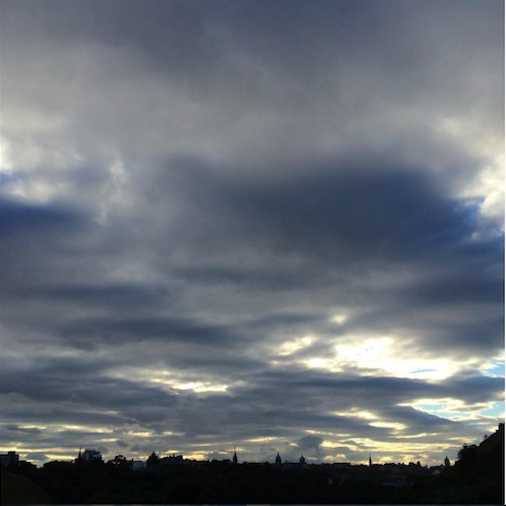
I’m sure the hostel bed isn’t helping, but my neck is still sore from the flight. I turned my head to look out the window as soon as we started to pull back from the gate and I didn’t turn back until Edinburgh was buried under a bank of clouds. Even then, I kept my head angled away from everyone else on the plane because tears are for pansies and my face was covered in them. I have never wanted to stay somewhere so badly. Still, conceal, don’t feel. Get it together. Stiff upper lip. Projecting strength is of primary importance when you’re traveling alone through life. Don’t let them see you cry.
Except…
Except that’s not what I learned this year. I didn’t learn how to shut people out, to fend them off with a show of force, be that force sass or intellect or silence. I already knew that. And I already knew how to handle the situation if strength didn’t keep people at arm’s length. Kindness does the trick there—you take care of yourself by taking care of others, building a layer of consideration and selfless acts around you so that when the barbs don’t scare people off, the sweetness makes them forget to pry. As long as you have your ish together, you can reject or deflect and stay safe for a very long time. This I know.
No, this year I learned what an ineffective strategy that is for building anything worth having. Great things are not achieved by a safe preservation of self and we all have the ability to achieve something great in our lives.
Okay, that’s maybe more grandiose of a point than I want to make. What I want to say is that you get the things in life really worth having by letting the world in, not by keeping it out.
I’m a fan of considering how lessons fit into the larger picture of life. I’m big on overarching themes. You may have noticed. I like to contextualize a thought and then generalize it, to place ideas within theoretical frameworks and push them. Consider, for example, the question, “Can you hug a whale?” I maintain that you cannot, but that really depends on what kind of whale and, more importantly, how you define a hug, and maybe how well language can describe what a hug is. Is a hug two sets of arms encircling two torsos? Do the arms have to completely close? Is a slight curvature of the forearms enough? Are arms or torsos crucial to the idea of a hug? What about intent and reciprocity? Do both people have to consciously consider it a hug for it to be a hug? I mean, none of that really matters because we all know what a hug feels like and hugging a whale would not feel like a hug. But you can’t really answer a question just based off feelings because (1) we could all just be brains in jars in a storehouse somewhere and (2) feelings and sensations are inherently problematic because there’s not a guarantee of perfect translation of information from your senses to your brain. You can’t really know what’s real unless someone else is there beside you saying, “Yeah, no, I can see/smell/hear/feel that too.” Then again, does something have to be externally verifiable to be true? History has shown that groups of people can be very wrong about the reality or plausibility or verity of objects or ideas. Even if you have a statistical majority of people who agree that you can in theory hug a whale, there are so many ways your sampling could be biased and anyway, are we really willing to hang the answer to this question on the opinions of a bunch of people who’ve never hugged a whale? To properly answer this, we’d need to consult a representative sample of people who have actually hugged a whale, but who’s going to fund that study? At the end of the day, it’d probably just be the anecdotal evidence of a dozen or so whale huggers and that’s hardly conclusive. It’s rather hopeless. This may remain one of the great unanswered questions of our time. And, since it has no answer, I wish to put forward my now plausible hypothesis that you can’t hug a whale, and even if you could, it wouldn’t be a hug worthy of the name. Snuggling, though, is a different matter entirely.
And that’s how you write a dissertation (or at least outline a collaborative paper).
There are piles of ideas you can have an academic discussion about. As a species, we decided a while ago that it’d be impossible for any one person to know everything, so we let people specialize their knowledge and report it back to the rest of us. In the best of all worlds, they’d find something they’re passionate about, research it, and then share what they’ve learned with everyone else. They get to experience the joy of discovery, we get the benefits of knowledge, and we all go on about our lives. There’s so much to be explored, so many questions we want to answer, so many we need to answer. Sometimes the scientific method is the best way to investigate something. Sometimes the storehouse of knowledge was built elsewhere. And therein lies the problem: who are the people who get to decide what the best way to study something is? How do we know who’s right?
The answers are we are and we don’t, but that’s maybe not nuanced enough to make anyone happy. It’s blunt enough to be argued with, simple enough to be questioned. But at the end of the day, we humans have to decide how we want to move forward in this world and if we are going to go forward in wisdom, that movement has to be done firmly holding the knowledge that we could be wrong in our heads, our hands, and our hearts.
That brings me back to letting the world in. New ideas, a better understanding of the world, they all come about by looking around you, seeing what’s there, listening to others, taking their points of view to heart, going through the hard work of stepping outside yourself to understand something that you never would have thought of on your own. I genuinely believe that we all learn better together.
At the beginning of the year, in September or October, we had our the first of many dinners together as a science and religion cohort at Don and Jan’s flat. The conversation ranged far and wide, I’m sure, but what I remember most is how I loudly stated that people are the worst and I hate them. (I’m still waiting on my plaque for Best First Impression Ever— the British post can be so slow sometimes!) I’m sure you’ve heard me say something similar if you’ve had a conversation with me in the past couple years. It was always such a relief to say, to affirm that my hope for humanity had been dashed to pieces by the depth of my life experience in my several years on the globe. Being jaded means you’re mature, I do believe. I wanted desperately to be mature, wanted my experience to count for something. I had not enjoyed being naively trusting.
Humans can be terrible and I do hate that. We tear holes in each other and the world, great ugly gashes that life fights against, builds defenses against. But we don’t have to be that. We never have to be that. We can be present in our lives, we can listen, we can strive to understand. We can watch someone like there’s no one else in the world for a few minutes. We can hug them with all the support and protection and affection they need in that moment. We can give and receive and rest, but I don’t think we can do any one thing for too long—life is that which struggles against and staying still means stagnation.
I wasn’t ready to go. I mean, you can overstay your welcome anywhere, be it a house or a city or a stage of life, but I was not—am not—ready to close out the Scottish chapter of my life. I did not want to leave those people or that place. It seems unfair that such a good thing could walk out of my life. But if nothing else, this year has taught me how to think and live and love better and I suppose that balances out the pain of leaving before the story feels done. Rounding the corners with overuse would have taken away the punch, I think. I hope. I’m sure.
Now if you’ll excuse me, I’m going to take my newfound knowledge, go sit in a corner, and sob while humming Auld Lang Syne to myself.
We’ll call it rest. For the moment.